This has to be one of my very favorite Sinningias. It's Gabriel's Horn. This is an easy to grow plant that has been in bloom for months.
This is a little gem called Nemomortonia mummularia. It's pouch-like flowers are a pleasant surprise on a humidity loving small-growing plant. (At least it's small growing for now...)
This isn't quite IN bloom, but it's close. I'm quite anxious to see what Columnea lehmannii is going to look like. I'm a fan of fuzzy flowers, and this one looks like it could be a winner!
This is Sinningia 'Polka Punch'. It grows a bit like a Smithiantha with the nice spike of flowers at the top. This one also seems to be happy to be multiplied... it has four or five "offspring" already.
Ok, now this is a little different, for those that like "weird". This is one of the relatively few (so far) yellow Streptocarpus named 'Alissa'. The yellow is spread throughout and there is only a bit of purple on the upper lobes.
Now this is also lovely, small and pretty cool. This is a Chirita linearis. Pretty pinkish flowers are held above the narrow foliage. A nice plant that doesn't take up too much space either.
And this isn't blooming, but the result of blooming. This is a little Columnea schiediana berry. Even the berry is fuzzy. Now there isn't anything to not love about that! This plant had another berry but sometimes the caretaker doesn't know just when berries are ripe. This one will be ripened a little more and the seeds hopefully sent to the Seed Fund. Please consider saving and sending in seeds to the fund. That's one way everyone has an opportunity to try out new and unusual varieties for a very reasonable price. Comments??? Questions??? It is very easy to leave either if you just click on the word below this and type your message.
Welcome to the Minnesota Gesneriad Society's website about all things Gesneriad! Join us for posts about Gesneriad culture, hybridizing, propagation and interesting topics relating to Gesneriads!
Saturday, February 26, 2011
Wednesday, February 16, 2011
Phragmipedium peruvianum

Say "hello" to something really incredible!
The University of Minnesota Landscape Arboretum is currently hosting a display of orchids for our friends at Orchids Limited in Plymouth.
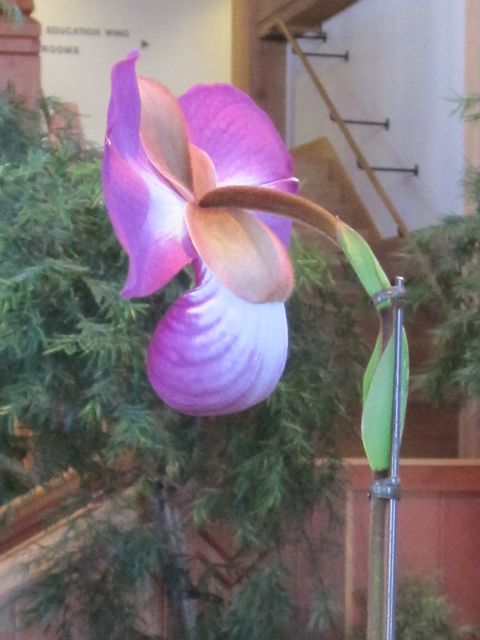
This is a rare and quite amazing orchid. It's a Phragmipedium peruvianum that was discovered (for the first time ever) in 2001 in the jungles of Peru.
It is called the most important orchid find in the last 100 years.
It is on display only through Saturday Feb 19. The rest of Jerry Fischer's orchids are on display there until March 13.This orchid is over 7" (seven amazing inches) across and as you can see it is an intense magenta color.
Orchids Limited acquired its legally collected seedling in 2005 and has one of only 10 plants in all of the United States to bloom. This is truly a special exhibit for orchid enthusiasts and for gesneriad lovers who sometimes also enjoy admiring other species of plants too!
Sunday, January 30, 2011
Now for the Winner!
How many of you recognize this? Club members will remember seeing this stunning plant at the CBS tour and winter meeting. I think the rather grand backdrop simply enhances the plant, and it's fancy ribbons too!
This Coelogyne cristata is worth the trip over to the show today! Be sure to congratulate our club pres. for displaying it as well!
Como Conservatory Winter Carnival Orchid Show
There is still time TODAY, Jan. 30, 2011, to to to the St. Paul Winter Carnival Orchid Show at the Como Conservatory!
Why???? Well, if these photos don't explain it better than I would, you just aren't in the mood to be impressed....
This is a display set up by three of our friends that also belong to the African violet group. SG, PK and JV really display amazing plants!
I really liked the orchid in the center...
These are just photos of a few of the hundreds of amazing plants.
The conservatory also displays part of their own "in house" collections. The scale is hard to tell here unless you look closely, but if the person in the far left is full size, look how incredibly huge the orchid in the left rear section of the photo is.
This thing was wild.... It had arching stems of these "puff balls" of flowers reaching all over the display.
Sometimes, you just have to be impressed.
Sunday, January 16, 2011
Kohleria eriantha
Now THIS is a Kohleria! The large flowers are about the size of a quarter across and you can see from the photo that it produces an abundance of them. Grown in ample light it will stay reasonably compact. The green leaves with red edges show a bit of a silvery color which contrasts nicely with the fuzzy orange flowers with the yellow face dotted with more orange spots.
The closeup shows the fine little hairs on the flower, some still holding on to moisture from the last watering.
Thursday, January 13, 2011
New [to us] Gesneriad
Drymonia oinochrophylla is attractive all year, glossy dark green leaves completely covering the plant. In the summer, it surprises me with a few large violet slipper flowers.
The flower is large, 2 to 3 inches long and and over and inch across. Drymonia flowers [on the ones I've grown] last 2 days. The color is vibrant, a good match for the leaves.
This plant is more than a foot across. The larger leaves are at least 3 inches long.
Very easy to grow and propagate, with some judicious pruning it will keep a dense shape; and
the prunings can make another plant.
This one is so easy. Add another genus to your collection.
Drymonia is a large genus, many long vines with unusual flowers. This species is compact and holds it's leaves well.
The orange flowers in front are Aeschynanthus humilis. More on this one in another post.
Wednesday, December 22, 2010
Some pictures of S. leucotricha to show the flowers on a mature specimen.
Click on a picture and open in a new window or tab, the larger image above has one flower in focus so you can see the hairs on the flower. The one below shows the hairs on the leaves.
This plant stayed in bloom for two months, from first flower until the last ones faded.
It is at least 5 years old. For the last several it has been in a greenhouse and had spent some summers out on my balcony behind a 40% shade cloth. The balcony gets full sun from around 10 am until 2 pm. In the greenhouse it gets about 50% of full sun in summer. It blooms about twice a year.
See the next post to see seedlings and a tuber being repotted.
December 23, 2010
Chas
I received three comments, here are the
Replies:
I took the photos. Please ask permission to use them. I'm thinking of printing one for an exhibit, to show what the species can do. Hopefully the seedlings will be on the sales table this spring.
I'd like to make this species available for everyone who wants one.
There also may be seedlings of S. reitzii and iarae.
My sinningia potting mix starts with the usual gesneriad mix of equal parts perlite, vermiculite and good Canadian peat moss. I add one part or more perlite and/or turkey grit for drainage, and a little charcoal for good luck. I use both the small and the coarse perlite, it all seems to work.
I put extra drainage material in the bottom of the pot, and sometimes use an orchid pot for the extra drainage holes.
I see the roots growing better in the faster draining mix. Clear pots are just so I can see the root system growing. Clay pots dry faster than plastic.
I prefer to use a pot 1 inch wider than the old pot. When I've gone from a 4 inch to a 6, or a 6 to an 8 inch pot, some of the tubers have rotted. The new soil stays wet a long time, and it takes a few months for the roots to fill the new soil. Once they do, the plant is fine.
That is one reason not to repot until the tuber fills the pot. We water heavily and often, so overwatering is always a risk. If you water only as the pot is starting to dry, you can use a more moisture retentive mix and repot before the tuber is pushing out the sides of the pot.
As always, what works in your growing conditions is best.
RO water has almost all the minerals removed. Jerry Fischer at Orchids Limited tells us to add 10% tap water to add back enough calcium, magnesium and trace minerals. Or add a little fertilizer - he sells his excellent blend as Green Jungle. U of Michigan formulas for RO water are fine. I can wait much longer to repot plants when using RO water. Also you can put a little agricultural lime or dolomitic lime in the soil mix.
I found the species sinningias grew fine with tap water in St Paul or with the RO water. If you're using tap water, I would flush the pot with plain tap water every couple months to remove mineral build-up.
Subscribe to:
Posts (Atom)