Friday, April 22, 2011

Sinningia iarae


A recent discovery in Brazil, and grown here from seed starting about 12 years ago.
Dozens of dusky rose hooded flowers form a ball above the four large, dark green leaves.
The leaves can be a foot above the tuber, and the flowers another foot above the leaves.
Related to S. leucotricha, it has the same form of four leaves on an upright stem that
blooms in a terminal inflorescence, and the stem eventually yellows and falls from the tuber.
An abscission layer forms at the base of the stem like a leaf in the autumn. New shoots come from the top of the tuber as the old stem declines. It blooms twice or more each year in cultivation. This plant has bloomed for more than 2 months each time.

The tuber on the biggest one at the greenhouse is over 6 inches across.
It grows in full sun in nature. Water well, give it a soil mix with perfect drainage, and fertilize weakly weekly when in growth. I like a clay orchid pot, and repot when the tuber fills the pot.
In plastic pots, it is time when the tuber is bulging the sides out. You may have to cut the pot away. In nature there is a dry season when the plant is completely dormant. In cultivation, it has stems and leaves all the time. If the old leaves are yellow but the stem doesn't fall off on its own, it can be cut about an inch above the tuber for appearance. Sometimes I cut the old stem off so the new one gets full sun.

Members of the chapter have produced more than a dozen seedlings from the original plant, now at the greenhouse.
The tuber will grow much faster the more sun the leaves get. See Mauro's website:
BrazilPlants.com
and Alan LaVergne's website:
Sinningias and Friends
http://www.burwur.net/sinns/4iarMain.htm

both are on the list of helpful websites on the right of the blog home page.

More photos to follow.
A couple seedlings may be available at the April meeting this Tuesday, April 26th
I have seed set on the big one now, and sinningia pods take about a month to ripen.
We sold all the seedlings we brought over to the CBS sale this week once we put the big one in bloom on display behind them. Thanks to Janice for bringing us plants to sell, including the iarae seedlings, and to Bob Eschbach, Jinean and Diane for volunteering at the sale.
We talked to students and faculty about gesneriads, handed out cards and sold a surprising number of plants. All proceeds went to the greenhouse.
And there are left over plants at CBS for sale, half price. The greenhouse is open to the public
8 to 4 Mon-Friday, and I will be there Tuesday late afternoon getting ready for the meeting.
If anyone wants to come over then, please email me ahead of time to let you in after 4.

Chas Huston

Wednesday, March 9, 2011

Voo Doo Fun!

This is a sweet little Voo Doo Lily. I can tell that it is going to send up a bloom because if you look closely at the tip of the spike, it's not a leaf that is breaking out of the outer covering.


Here is a better shot of it just starting on it's way to something much more spectacular.


h


It's been out for more than a week now and it's starting to turn from a light green to it's more traditional burgundy red.


It's about five feet high at this point and you can see that the frill around the flower is also starting to color and open. Wikipedia was responsible for the following:
As is typical of the Arum family, these species develop an inflorescence consisting of an elongate or ovate spathe (a sheathing bract) which usually envelops the spadix (a flower spike with a fleshy axis). The spathe can have different colors, but mostly brownish-purple or whitish-green. On the inside, they contain ridges or warts, functioning as insect traps.
The plants are monoecious. The spadix has tiny flowers: female flowers, no more than a pistil, at the bottom, then male flowers, actually a group of stamens, and then a blank sterile area. This last part, called 'the appendix', consists of sterile flowers, called staminodes, and can be especially large. There is no corolla.


It's almost open now.


It's seven feet high and most amazing. The color is intense as well as another most intriguing feature of these particular flowers.


It can be known as a "corpse flower" because it produces an intense (note the underwhelming descriptor here) fragrance that is most offensive to humans (but insects loveeeee it!)


My wonderful flower has taken a three day sabbatical in a tiny closed room in the basement with a towel in front of the crack in the bottom of the door where floor meets door. There is a mighty good reason for this.


But you will be happy to note that now that it's "intense" days are over it will get to come and regain it's prime real estate in the sun room... if it is REALLY and TRULY done with "the phase".

Saturday, February 26, 2011

Sinningia 'Gabriel's Horn', S. 'Polka Punch', Nemomortonia mummularia, Columnea lehmannii, Streptocarpus 'Alissa', Chirita linearis, and Columnea schiediana are BLOOMING!!!

This has to be one of my very favorite Sinningias. It's Gabriel's Horn. This is an easy to grow plant that has been in bloom for months.


This is a little gem called Nemomortonia mummularia. It's pouch-like flowers are a pleasant surprise on a humidity loving small-growing plant. (At least it's small growing for now...)


This isn't quite IN bloom, but it's close. I'm quite anxious to see what Columnea lehmannii is going to look like. I'm a fan of fuzzy flowers, and this one looks like it could be a winner!


This is Sinningia 'Polka Punch'. It grows a bit like a Smithiantha with the nice spike of flowers at the top. This one also seems to be happy to be multiplied... it has four or five "offspring" already.


Ok, now this is a little different, for those that like "weird". This is one of the relatively few (so far) yellow Streptocarpus named 'Alissa'. The yellow is spread throughout and there is only a bit of purple on the upper lobes.


Now this is also lovely, small and pretty cool. This is a Chirita linearis. Pretty pinkish flowers are held above the narrow foliage. A nice plant that doesn't take up too much space either.


And this isn't blooming, but the result of blooming. This is a little Columnea schiediana berry. Even the berry is fuzzy. Now there isn't anything to not love about that! This plant had another berry but sometimes the caretaker doesn't know just when berries are ripe. This one will be ripened a little more and the seeds hopefully sent to the Seed Fund. Please consider saving and sending in seeds to the fund. That's one way everyone has an opportunity to try out new and unusual varieties for a very reasonable price. Comments??? Questions??? It is very easy to leave either if you just click on the word below this and type your message.

Wednesday, February 16, 2011

Phragmipedium peruvianum


Say "hello" to something really incredible!

The University of Minnesota Landscape Arboretum is currently hosting a display of orchids for our friends at Orchids Limited in Plymouth.


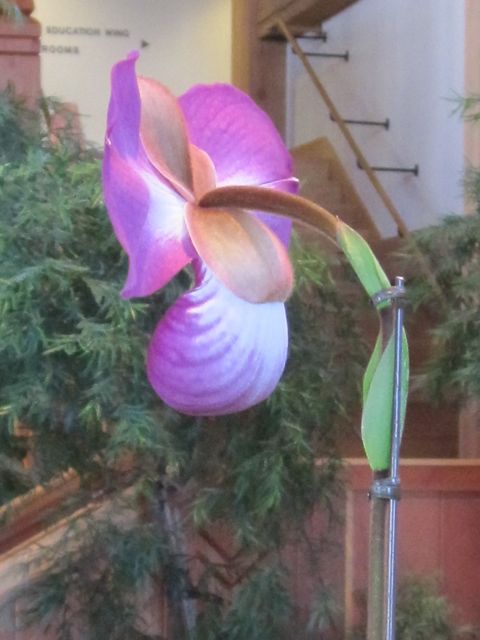
This is a rare and quite amazing orchid. It's a Phragmipedium peruvianum that was discovered (for the first time ever) in 2001 in the jungles of Peru.

It is called the most important orchid find in the last 100 years.

It is on display only through Saturday Feb 19. The rest of Jerry Fischer's orchids are on display there until March 13.


This orchid is over 7" (seven amazing inches) across and as you can see it is an intense magenta color.


Orchids Limited acquired its legally collected seedling in 2005 and has one of only 10 plants in all of the United States to bloom. This is truly a special exhibit for orchid enthusiasts and for gesneriad lovers who sometimes also enjoy admiring other species of plants too!

Sunday, January 30, 2011

Now for the Winner!

How many of you recognize this? Club members will remember seeing this stunning plant at the CBS tour and winter meeting. I think the rather grand backdrop simply enhances the plant, and it's fancy ribbons too!

This Coelogyne cristata is worth the trip over to the show today! Be sure to congratulate our club pres. for displaying it as well!


Como Conservatory Winter Carnival Orchid Show

 There is still time TODAY, Jan. 30, 2011, to to to the St. Paul Winter Carnival Orchid Show at the Como Conservatory!

Why???? Well, if these photos don't explain it better than I would, you just aren't in the mood to be impressed....
 This is a display set up by three of our friends that also belong to the African violet group. SG, PK and JV really display amazing plants!
 I really liked the orchid in the center...
 These are just photos of a few of the hundreds of amazing plants.
 The conservatory also displays part of their own "in house" collections. The scale is hard to tell here unless you look closely, but if the person in the far left is full size, look how incredibly huge the orchid in the left rear section of the photo is.
 This thing was wild.... It had arching stems of these "puff balls" of flowers reaching all over the display.
Sometimes, you just have to be impressed.

Sunday, January 16, 2011

Kohleria eriantha

Now THIS is a Kohleria! The large flowers are about the size of a quarter across and you can see from the photo that it produces an abundance of them.
 Grown in ample light it will stay reasonably compact. The green leaves with red edges show a bit of a silvery color which contrasts nicely with the fuzzy orange flowers with the yellow face dotted with more orange spots.
The closeup shows the fine little hairs on the flower, some still holding on to moisture from the last watering.